Tucked away on a specially designated shelf in the Llano County Public Library, each branded with a red dot on its spine reminiscent of a scarlet letter, 17 books quietly await their fate. One features a farting leprechaun, another a kid with a broken butt. Others tackle heftier topics, such as the history of racism, the KKK, and transgender voices. Despite their varied subjects, the books have all been deemed inappropriate by Llano County officials and removed from their ordinary spots on the shelves.
Tucked away on a specially designated shelf in the Llano County Public Library, each branded with a red dot on its spine reminiscent of a scarlet letter, 17 books quietly await their fate. One features a farting leprechaun, another a kid with a broken butt. Others tackle heftier topics, such as the history of racism, the KKK, and transgender voices. Despite their varied subjects, the books have all been deemed inappropriate by Llano County officials and removed from their ordinary spots on the shelves.
These 17 books are at the center of a high-profile lawsuit that has made its way to the U.S. Court of Appeals for the Fifth Circuit. Trinity University alumni Noah Hagey ’95 and Katherine Chiarello ’95 and their law firms represent seven library patrons suing officials with the Llano County library system and the county government for restricting access to information. Though Llano County, located around 70 miles northwest of Austin, is home to only about 21,000 people, the case has made national headlines for its implications regarding censorship in public libraries.
In March 2023, the district court ordered a preliminary injunction barring the library from removing the 17 books from shelves while litigation is ongoing. The defendants appealed that decision and, in June 2024, a divided three-judge Fifth Circuit panel upheld the injunction for eight of the books. The order was vacated in July, though, and the alumni returned to court in September for a rehearing en banc by 18 members of the Fifth Circuit. As of press time, Chiarello and Hagey await the court’s decision, and the books remain on the shelves.
Pages Under Pressure
The Llano County case is just one of many book-banning cases currently circulating through the legal system, with closely watched litigation ongoing in Arkansas, Florida, Iowa, and Alaska. Each case typically centers on the same question: Is it constitutional to censor the books people can access?
“At its core, book banning involves some individual or group essentially saying, ‘I don’t like this content or idea for some reason, and thus it should not be available or not exist,’” explains Tom Payton, director of Trinity University Press.
Book removal, or “banning,” has been around since the 1600s, with several landmark court cases happening in the past 80 years ultimately protecting readers’ rights to choose their books. With decades in the publishing industry, Payton has seen calls for book bans in many forms—not just with libraries, but also with booksellers—and for many reasons, from religious and economic to political and social.
“Book banning comes from all types of agendas,” Payton says. “And it has been around for a while. It’s not anything new.”
What is new is the sharp increase in calls for book bans over the past three years. The American Library Association (ALA) reported 4,240 unique book titles targeted for censorship in 2023, a 65% surge over 2022 numbers and the highest level ever documented by the organization. Texas is one of the top states for book challenges (second only to Florida), with 1,470 titles challenged in 2023.
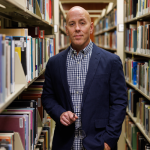
“We’re a big state, and we like to throw our weight around,” says Benjamin Harris, MLIS, Trinity’s dean of Coates Library. “Consider the way a successful challenge in Texas can support or encourage similar challenges elsewhere. When it happens here, people know about it. Our influence in the wider conversation about these issues is tangible.”
Nearly half of the challenged titles in 2023 represented LGBTQ+ and BIPOC voices, as do some of the books in the Llano County case. While some might link this to Texas’ conservative culture, Harris contends that Texans are vocal regardless of their political beliefs. Hagey even points out that the seven plaintiffs in the Llano County case don’t all share the same political views.
“This case is not a partisan issue because no Texan wants the government to tell them what they can and cannot read,” Hagey says. “We all get to choose what we read.”

Library Litigation
The Llano County case is receiving national attention because it is one of the first book-ban court cases involving a public library. Book challenges at public libraries are growing fast—up 92% in 2023 over the previous year, according to the ALA—with court cases sure to follow, so the Llano County case is poised to set a precedent for future disputes.
Most book-challenge court cases involve school libraries and the extent of protecting children from content potentially deemed inappropriate. Public libraries serve entire communities, though, raising the question: Who gets to decide what the public can read?
This is the core debate of the Llano County case. Library patrons argue that the removal of the 17 books is unconstitutional, infringing on free speech. Llano County officials counter that this is a form of constitutionally protected government speech, giving them the unfettered right to determine which books go on shelves. So, whose free speech takes priority—the citizens’ or the government’s?
Payton frames it as a question of the library’s responsibility to the public. “If I want it, is it my library’s responsibility to have it?” he says. He expects more pushback in the future as millennials and Gen Z’ers, known for being vocal about issues important to them, have become the primary people visiting libraries, according to Pew Research. “They want to read what they want to read, and they envision the library as a place where that should be available,” Payton says. “They think, ‘If I want to read it, it should be accessible to me.’”
Chiarello highlights another question: Who bears responsibility for children’s access to books—the parents or the public library? Some of the 17 challenged titles are for children, removed under the pretense of protecting young readers from inappropriate content.
“I don’t think anyone wants to co-parent with the government,” Chiarello says. “It’s up to us [as parents]. If there are books that I don’t want my children to have access to, I’m responsible for enforcing that.”
Chiarello mentions that one of the challenged books in the Llano County case is a sex education book recommended by her daughter’s pediatrician. Next to it on the shelf in the Austin public library, she says, is another child-focused sex education book from a different perspective.
“It’s not the perspective that I want my daughter to read, but our librarian has seen that there are other parents in our community who want their children to think about puberty through a lens different from mine, and she has chosen books accordingly,” Chiarello says. “It’s important that all of those ideas are available in the library, even if they are offensive to some people.”
Harris sees parallels between the open access to ideas both in a public library and in a liberal arts education. “A liberal arts education is committed to engaging with and considering the widest possible range of ideas and perspectives,” he says. “Exposure to a broad range of voices can help you confirm your own place and position in a conversation.”
Hagey sees the Llano County case as part of a broader struggle against the polarization of ideas in America. “Constructing our public library systems or other public institutions to censor or guard against particular ideas is a terrible idea,” he says. “It’s contrary to the First Amendment.”
Partnering for Purpose
Hagey’s not unfamiliar with cases dealing with big-picture constitutional rights. He is the co-founder and managing partner of BraunHagey & Borden LLP, a successful bi-coastal law practice that emphasizes impact litigation—taking on issues other firms might shrug off in favor of more profitable ones.
“The impact practice was always centered around doing things at the core of what I always thought being a lawyer was about, which is engaging in the harder, bigger questions of the day and trying to do good,” Hagey says. “You don’t think, ‘How am I going to get paid?’ It’s more, ‘These are bad things that are happening, so let’s put some force and effort behind stopping them.’”
Chiarello is a founding partner at Botkin Chiarello Calaf, an Austin-based practice that focuses on business litigation. Chiarello’s firm partnered with Hagey’s firm for this case to offer a strong local presence near Llano County. “Each of us [at the firm] has a personal commitment to doing good in the world with our law degrees,” Chiarello says of her practice, which has taken on cases such as asylum work and challenging the constitutionality of the winner-take-all electoral college system.
Though the two only crossed paths in their pre-law courses at Trinity—Hagey was a political science and business administration double major on the Tiger baseball team, while Chiarello was a political science major, first-year mentor, and member of Sigma Theta Tau—they both attended the University of Texas School of Law after graduation. From there, Hagey built his law firm, which spans from San Francisco to New York, and Chiarello worked in California and Washington, D.C., before returning to Texas.
“I’m proud that we both busted out of our region,” Chiarello says. “We’re examples that you can take a Trinity degree and go anywhere with it.”

Battles of the Brain
Hagey and Chiarello agree that the basis of the law practice is advocacy, which isn’t possible without understanding all sides involved.
“To be an effective advocate for your side, you have to be able to see the case from the other side’s perspective,” Chiarello says. “That’s what shows weaknesses in your own position, and it’s what helps you expose the weaknesses in the other side’s position. I think a liberal arts education—being intellectually curious and looking at issues from all different sides—helps us be better advocates for our clients.”
“The best universities, like Trinity, expose students to different and competing ideas within a liberal arts education,” Hagey adds. “They prepare you for the broader controversies in one’s personal or professional life and for society as a whole. Whatever one may think about the individual books at issue, this case is about that liberal tradition, our First Amendment protection, and our libraries as places that have all kinds of books.”
Hagey says that the late Coleen Grissom, Ph.D., introduced this concept of neuroplasticity in her invocation for first-year students when he first arrived at Trinity. “It’s all about getting competing ideas, competing concepts, and letting them do battle together,” he says. “That was why I loved my Trinity education. It was full-on combat with all kinds of interesting ideas and perspectives.”
Chiarello found this especially relevant for her oral argument in June during the case’s appearance in federal appeals court.
“I knew that there might be judges who would agree with me and judges who would not agree with me on that panel,” she says. “And so having trained, as Noah said, to do battle with competing ideas helped because I wasn’t just arguing my client’s position. I was doing battle with, ‘What is the other side saying? What is the strength in their argument, and how do I respond?’
“Trinity didn’t teach me what to think. It taught me how to think,” Chiarello continues. “And we think that’s important for all members of the community. The public library is a place where the First Amendment protects your right to have wide access to different ideas, because the library shouldn’t tell you what to think—it should help you figure out how to think.”